

What are the essential legal documents required alongside the deed of probate to ensure a smooth property transaction?
Alongside the deed or grant of probate, a property sale will usually require the original will, the death certificate, proof of the executor’s identity, the Land Registry title documents and any inheritance tax confirmation or relevant HMRC forms. The conveyancer may also need details of any mortgage or restriction, authority from all acting executors, and completed property information and fittings forms before contracts can be exchanged.
The essential documents alongside a deed of probate—more commonly called a grant of probate in England and Wales—are those that prove the personal representative’s authority, clarify the property’s legal and practical position, and allow the buyer’s conveyancer to investigate title. The precise list depends on the property, the estate and the UK jurisdiction in which it is located.
Evidence of authority to sell
- A sealed or official copy of the grant should be supplied to the conveyancer. It confirms who has legal authority to administer the estate and deal with the property.
- Where there is more than one executor, the conveyancer will need to establish that every acting executor is participating in the transaction, unless one has formally renounced or reserved power to act.
- If the named executor cannot act, documents explaining the change in representation may be required. The correct document could be a grant of letters of administration with the will annexed, a further grant, or another document issued by the Probate Registry.
- Where the property is in Scotland, the equivalent authority is generally confirmation rather than a grant of probate. Northern Ireland has its own probate procedure and terminology, so the conveyancer should be told where the property is situated at the outset.
Documents about the property’s occupation and use
- A tenancy agreement, licence to occupy or other occupational agreement is needed if somebody rents or occupies the property. The buyer must understand whether the property can be given with vacant possession and whether any notice or separate arrangement is required.
- Details of tenants’ deposits, rent accounts and any ongoing disputes may also be relevant. Failing to disclose an occupation arrangement can delay enquiries or create a dispute after completion.
- For a leasehold property, the lease and any deed of variation should be provided where available. The buyer’s solicitor may also require evidence concerning ground rent, service charges, notices, consent requirements and the lease term.
- A landlord’s or managing agent’s information pack may be necessary for a flat or managed development. It can include replies about planned works, transfer fees, insurance and compliance with the lease.
Planning, building and environmental records
- Planning permissions, listed-building consents, building-regulations completion certificates and certificates of lawful use should be supplied for relevant alterations or changes of use.
- Guarantees, warranties and installation certificates for works such as an extension, replacement windows, electrical work, roofing or damp treatment can help answer the buyer’s enquiries.
- Any notices from a local authority, party-wall agreement, enforcement correspondence or evidence of planning breaches should be disclosed rather than omitted because the work was carried out before the owner’s death.
- Where the property has private drainage, shared access, a septic tank, solar panels or other unusual features, the relevant agreements, maintenance records and ownership documents may be required.
Financial and completion documents
- A current redemption statement is normally needed where borrowing is secured against the property. This allows the conveyancer to calculate what must be paid from the sale proceeds so the charge can be released.
- Evidence of buildings insurance can be relevant, particularly for leasehold or unusual properties, and the buyer’s solicitor may ask how cover will continue between exchange and completion.
- Receipts and accounts for ground rent, service charges, council tax, utilities and property works help the conveyancer calculate apportionments and identify outstanding liabilities.
- If the estate has agreed a sale below market value, transferred an interest to a beneficiary, or has multiple beneficiaries with differing interests, written evidence of the relevant agreement may be needed. The executor should obtain legal advice before entering into a transaction that could be challenged by beneficiaries or creditors.
Information for the conveyancing forms
The conveyancer will usually ask the executor to answer detailed questions about boundaries, rights of way, disputes, notices, alterations, flooding, contamination and services. The executor may need to inspect the deceased’s papers, contact the managing agent or local authority, and confirm when the information cannot be verified. Answers should be accurate and based on reasonable enquiries; guessing can expose the estate to a claim.
Checks before contracts are exchanged
- Give the conveyancer the probate authority and explain who is entitled to sign on behalf of the estate.
- Identify whether the property is freehold or leasehold and gather the relevant occupational, lease and management records.
- Locate permissions, certificates, guarantees and agreements for alterations or unusual property features.
- Obtain up-to-date financial information so secured lending, service charges and other completion adjustments can be dealt with.
- Review the conveyancer’s enquiries carefully and disclose any uncertainty or missing document before exchange rather than relying on an assumption that it will not matter.
A missing document does not always prevent a sale. The conveyancer may be able to obtain an official copy, request replacement information, use an indemnity policy where appropriate, or explain the issue to the buyer. An indemnity policy is not a substitute for disclosure and may be unsuitable where a known defect or active dispute exists, so its use should be approved by the conveyancer.
For an executor considering a direct cash sale, the same legal evidence is still relevant. A buyer can agree commercial terms without an estate agent, but ownership, authority, title, property condition and completion arrangements must still be verified through conveyancing. Keeping the documents together in a clearly labelled estate file and sending copies to the appointed conveyancer helps prevent avoidable enquiries and gives all parties a clear record of the transaction.
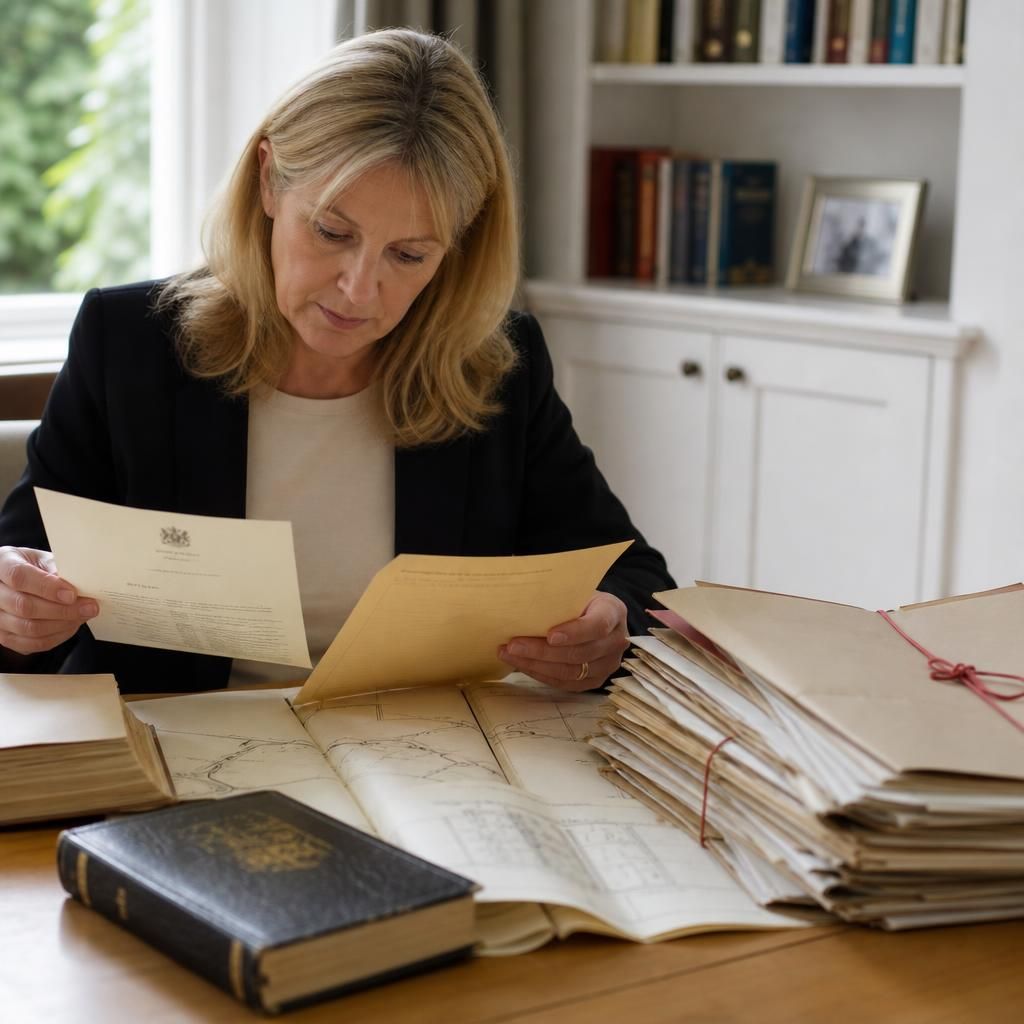
For an unregistered probate property, the conveyancer will need historic title evidence because there is no Land Registry title register to confirm ownership. This may include the original conveyances, deeds, plans, mortgages and releases, together with an abstract or epitome of title showing how ownership passed to the deceased.
These papers should be reviewed carefully for inconsistencies in names, boundaries, rights of way or missing deeds. If the originals cannot be located, the conveyancer may need to investigate alternative evidence and consider whether an application for possessory or another form of registered title is appropriate. Locating the complete title history before marketing the property helps identify problems that could otherwise interrupt the transaction after a buyer has been found.