

What is the process for accurately evaluating all assets in an estate, including real property, personal items, and financial investments, for probate purposes?
Accurately valuing an estate for probate involves identifying every asset, establishing its open-market value at the date of death, and retaining evidence for each figure. This includes obtaining appropriate valuations for property and personal possessions, checking financial statements and investments, and recording the results in a clear estate inventory for probate and inheritance tax reporting.
An accurate probate valuation is a documented calculation of what the deceased owned, or was beneficially entitled to, at the date of death. The process combines legal ownership checks with suitable valuation methods for land, personal possessions, bank accounts, investments, business interests and other property, producing figures that can support the probate application and any inheritance tax reporting.
1. Establish the estate’s scope
Begin by reviewing the deceased’s will, personal papers, property records, bank correspondence, tax documents and digital accounts. The purpose is to distinguish assets belonging to the estate from items held for someone else, assets passing automatically to a surviving joint owner, and arrangements governed by separate trust or nomination rules.
Make an initial schedule containing the asset description, ownership status, account or policy reference, estimated value, valuation source and any evidence still required. This working schedule should be updated as information is verified rather than treated as the final estate account.
2. Confirm ownership and beneficial entitlement
Legal title does not always show the whole value that must be considered. For a property, check the Land Registry title, ownership structure, mortgage position and any declaration of trust. Jointly owned property may pass by survivorship or may form part of the deceased’s estate according to the type of joint ownership and the beneficial interests involved.
Apply the same care to bank accounts, investment portfolios, vehicles, business interests and valuable possessions. Where ownership is disputed, documentation is incomplete or another person claims an interest, retain the relevant agreements and obtain legal advice before adopting a final figure.
3. Value land and buildings
Property should normally be assessed at its open-market value at the date of death, taking account of its condition, location, size, tenure, planning position, restrictions and comparable sales. The valuation should reflect the property as it existed on that date, not improvements or deterioration that occurred later.
A written valuation from a suitably qualified independent surveyor can be appropriate, particularly for a high-value, unusual, tenanted, development or disputed property. The report should identify the valuation date, explain the method used and state any assumptions. Keep details of comparable evidence and disclose known defects, leases, rights of way, planning restrictions and environmental issues.
Do not automatically deduct a mortgage from the property’s gross value. Record the property value separately and deal with secured borrowing in the liabilities section of the estate accounts and the relevant tax calculation. This creates a clear audit trail between gross assets, deductions and the net estate.
4. Assess personal possessions consistently
Prepare a room-by-room or category-by-category list of jewellery, artwork, antiques, collections, vehicles, furniture, electronic equipment and other items with material value. Ordinary household contents may have limited individual value, but items should not be dismissed without reasonable consideration where there are indications of rarity, provenance or specialist interest.
Use recent comparable sales, specialist auction advice, insurance documentation and dealer or surveyor reports where appropriate. Replacement cost is usually not the same as the amount obtainable on the open market. Record whether an estimate represents auction value, private-sale value or another basis, and use the basis consistently across similar items.
Photographs, serial numbers, receipts, certificates, previous insurance schedules and provenance documents help substantiate the assessment. If items are sold after death, the sale price may provide useful evidence, although it should not automatically replace the date-of-death valuation if market conditions, sale costs or the item’s condition differ.
5. Obtain balances for cash and financial accounts
Request official statements or date-of-death certificates for current accounts, savings accounts, deposit accounts, cash management accounts and other cash holdings. The evidence should show the balance at the relevant date and identify any interest accrued but not yet credited.
For shares, funds, bonds and similar investments, obtain a portfolio valuation from the provider or calculate the value using reliable market records for the date of death. Check the number and class of securities, quoted price, accrued income, dividends declared but unpaid, dealing restrictions and any charges that are relevant to the chosen valuation basis.
Review ISAs and other tax-advantaged investments carefully. Their tax treatment may differ from ordinary investments, but their ownership and destination still need to be recorded accurately. Pensions and life policies may be payable under a nomination or trust and may not form part of the probate estate in the same way as an ordinary bank account. They should nevertheless be investigated and documented so that potentially relevant information is not omitted from the wider estate review.
6. Investigate less obvious assets
A complete assessment may include business interests, partnership capital, loans owed to the deceased, intellectual property, royalties, refunds, digital assets, foreign property and contents held in storage. Search correspondence, tax returns, company records, online accounts and financial statements for evidence of these interests.
Business assets often require accounts, share agreements, partnership documents and an independent valuation. The value may depend on restrictions on transferring the interest, the company’s financial position and the deceased’s percentage holding. Do not assume that a company’s gross asset value equals the value of the deceased’s shares.
For foreign assets, obtain local ownership and valuation evidence and consider exchange-rate records for the valuation date. Specialist advice may be required where another country’s succession, tax or reporting rules apply.
7. Consider gifts, nominations and trust arrangements
Review records for significant gifts, transfers, jointly held assets, trusts and policies written in trust. Some interests may not pass through probate but can still be relevant to inheritance tax or to the explanation of how the deceased’s wealth was held.
Look for evidence such as gift letters, bank transfers, trust deeds, policy documents and correspondence with financial advisers. Avoid treating an informal family understanding as proof of ownership without checking the underlying legal documents.
8. Apply appropriate valuation adjustments
The gross figure may need careful treatment where an asset is jointly owned, subject to a lease, difficult to sell, restricted by an agreement or connected to other assets. Any discount or adjustment should be supported by facts rather than applied as a general percentage.
Where several assets are sold together, the combined sale evidence may not show what each item was worth individually. Explain the allocation method used. Similarly, a later sale below the initial estimate does not automatically prove that the original valuation was wrong; market movements, selling expenses and the timing of the sale must be considered.
9. Check the figures and preserve evidence
Reconcile valuations against bank statements, title documents, investment schedules and the deceased’s known income. Check that dates, ownership shares, account numbers and units held are consistent. Investigate unexplained transfers, duplicated entries, missing accounts and assets appearing in the will but not in the financial records.
Keep valuation reports, statements, photographs, correspondence, calculations, comparable evidence and notes of professional advice with the estate papers. Each figure should be traceable from the final schedule back to its source. If an estimate is provisional, mark it clearly and replace it when better evidence becomes available.
10. Prepare the final estate schedule
Present the results in clear categories, normally showing the asset description, ownership share, gross value at the date of death, valuation basis and supporting document. Separate assets that pass through probate from those considered for wider inheritance tax analysis where the rules require that distinction.
Before submitting information, the personal representative should review the schedule with the solicitor, accountant or other relevant adviser where the estate is complex. Professional input is particularly important for disputed ownership, business interests, overseas property, unusual personal items, trusts, substantial gifts or valuations that may be challenged.
The objective is not simply to produce a total. It is to show how every material figure was reached, why the selected valuation method is appropriate and how the evidence supports the estate’s position at the date of death.
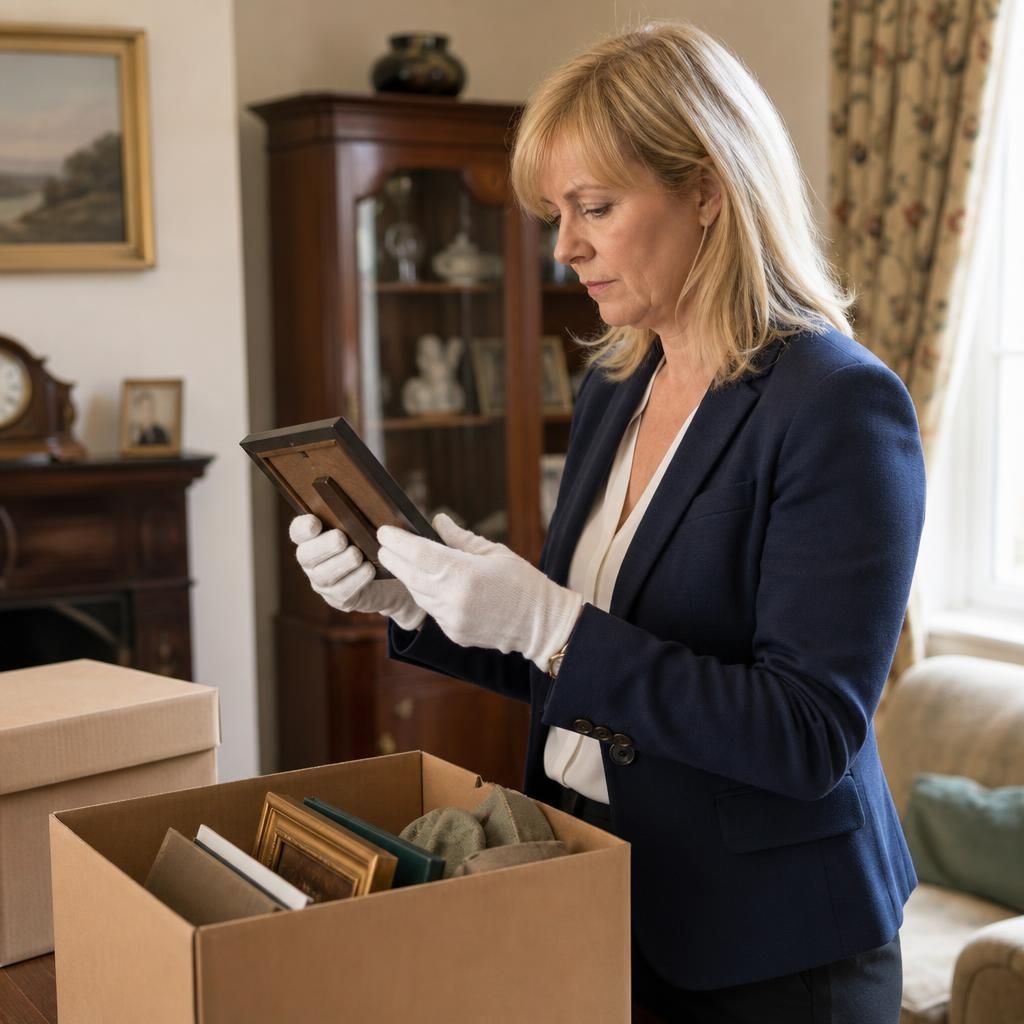
Safeguarding the estate before valuation is an important part of obtaining accurate figures. Until each item has been identified and assessed, keep possessions together where practical, restrict unauthorised removal and record their location and condition. Photographs taken before clearance, repairs or disposal can show what existed at the date of death and help distinguish estate assets from later additions or replacements. If an item must be moved, sold or disposed of for practical reasons, record who authorised the action, when it occurred and any amount received. This prevents changes during administration from undermining the evidence used to support the probate valuation.