

What factors should be considered when determining the price of an as-is property?
The price of an as-is property should reflect its location, size, tenure, current condition, likely repair costs, local demand and comparable recent sales. Adjust the valuation for legal or planning issues, structural defects, occupancy complications and the costs or risk a buyer will take on after purchase.
An as-is property should be priced according to its realistic market value in its present state, rather than the value it might achieve after renovation. A sound valuation combines verified property information, comparable evidence and a reasoned allowance for the uncertainty, expenditure and risk a purchaser may inherit.
Start with the correct valuation basis. Decide whether you are estimating an open-market asking price, an expected agreed sale price or the amount likely to be offered by a cash buyer. These are not necessarily the same. An asking price may allow room for negotiation, while an offer reflects the buyer’s assessment of costs, risk and the likelihood of completing the purchase. An independent RICS valuation can provide a formal opinion, although a valuation is not a guarantee of the eventual sale price.
Verify the property details before comparing prices. Check the Land Registry title, floor area, plot boundaries, number and use of rooms, parking arrangements and any extensions or alterations. A listed floor area that differs materially from the actual accommodation can distort comparisons. Treat loft rooms, outbuildings and converted garages carefully: they may add practical value without having the same value as fully compliant living accommodation.
Assess how buyers will fund the purchase. Some defects or unusual construction methods can restrict mortgage availability. If the likely buyer pool is limited to cash purchasers, the price may need to reflect reduced competition and the buyer’s need to fund works without mortgage support. This is not an automatic discount, but it is a relevant marketability consideration.
Include transaction and holding costs in the calculation. A purchaser may allow for survey fees, specialist reports, insurance, finance, legal work, clearance, security and the cost of keeping the property while work is arranged. If the property is empty, damaged or difficult to insure, those costs can affect the offer. The seller should not simply deduct every possible expense from an ideal renovated value: only costs that are reasonably supported by the property’s circumstances should influence the adjustment.
Separate known costs from uncertainty. Obtain written estimates where the work is substantial, and distinguish essential works from improvements that would merely modernise the property. A buyer will usually price the risk of discovering additional defects, so a clear schedule of known issues can produce a more credible valuation than an unexplained reduction. Contingency should be considered for work that cannot be properly assessed without opening up floors, walls or roofs.
Consider condition beyond visual appearance. The valuation should reflect the age and remaining life of major elements such as the roof, windows, heating system, electrics, plumbing and damp-proofing. It should also account for waste removal, cleaning, garden clearance, pest treatment or reinstatement after damage where these affect the property’s usable condition. Cosmetic datedness normally has a different effect from defects that create safety, insurance or financing concerns.
Review documents that affect certainty of ownership or use. Restrictions on the title, missing rights of way, access disputes, restrictive covenants, unresolved boundary matters and absent completion certificates can all influence price. Leasehold properties require particular attention to the unexpired term, ground rent, service charges, major works demands, transfer requirements and any consent needed for alterations. The impact depends on whether the issue can be resolved, how much resolution may cost and whether it prevents a buyer or lender from proceeding.
Check planning and building-control history. An extension, conversion or change of use may have value only if its status is acceptable to the market. Where paperwork is missing, indemnity insurance may sometimes be considered, but it does not cure defective work or provide retrospective approval. Do not add the full apparent value of an alteration until its lawful use, construction quality and effect on resale have been assessed.
Analyse comparable sales properly. Use completed sales of genuinely similar properties where possible, giving priority to nearby homes with comparable tenure, accommodation, plot characteristics and buyer appeal. Asking prices show seller expectations rather than achieved value. Adjust the evidence for differences in condition, presentation, specification, access, parking, outdoor space and sale circumstances. A single high or low transaction should not determine the price without understanding why it differed from the subject property.
Account for timing and saleability without confusing them with urgency. A property that appeals to a narrow group may require a sharper price to attract sufficient interest, particularly where viewings, access or information are difficult to arrange. Conversely, distinctive features can support a stronger price if they appeal to a clearly identifiable group of buyers. The relevant question is not simply whether the property is imperfect, but how many purchasers are likely to consider it and what alternatives they have.
Use a transparent adjustment process. A practical calculation is to establish a range from comparable evidence, then adjust it for documented works, legal or technical uncertainty, buyer costs and marketability. Record each adjustment and the evidence behind it. This helps avoid double-counting: for example, a comparable sale already in poor condition should not be reduced again for the same defect unless the subject property has an additional problem.
Before setting the figure, gather the title information, lease documents where relevant, planning records, survey findings, repair quotations and details of any occupants or agreements affecting possession. Reassess the price if a survey reveals a material defect or if a legal issue changes the group of buyers able to proceed. For an owner seeking a straightforward as-is sale, comparing an estate-agent appraisal, an independent valuation and a written cash-purchase assessment can clarify the difference between a market asking price and an offer based on the risks being accepted.
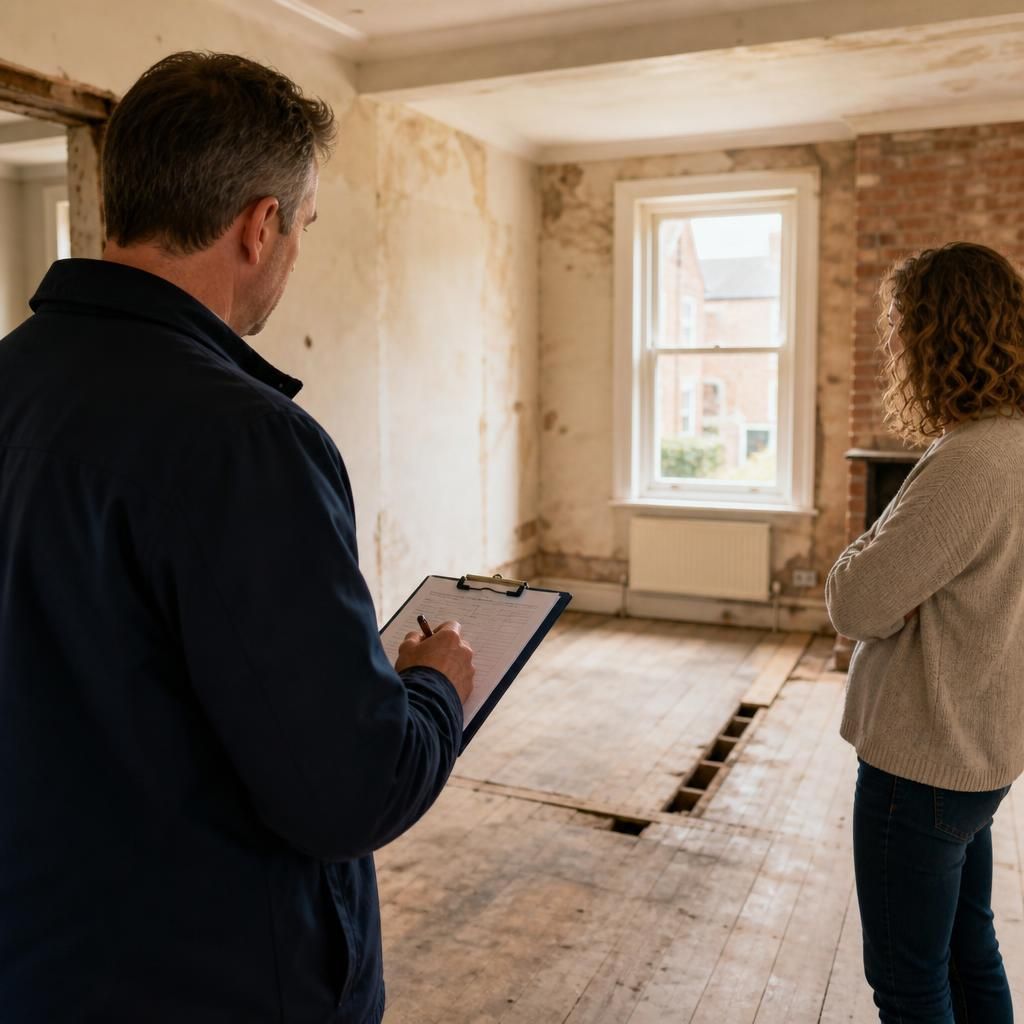
An as-is valuation should state the assumptions on which it is based, because a price can change materially if those assumptions prove incorrect. For example, the assessment may depend on vacant possession, continued access to the property, working services or the ability to inspect areas that are currently concealed. If any of these points is uncertain, the uncertainty should be recorded rather than hidden within an unexplained discount.
This makes the valuation easier to review when further information becomes available. It also helps distinguish a genuine change in value from a change in the assumptions used to calculate it. Ask any valuer or potential buyer to identify these assumptions clearly, particularly where the property has occupants, restricted access or incomplete information.
Discuss Your As-Is Property Valuation
Share your property details and any relevant documents with buyhousesfast.co.uk to discuss an as-is valuation based on its current condition and circumstances. This can help you compare a written cash-purchase assessment with other valuation evidence before deciding how to proceed.